
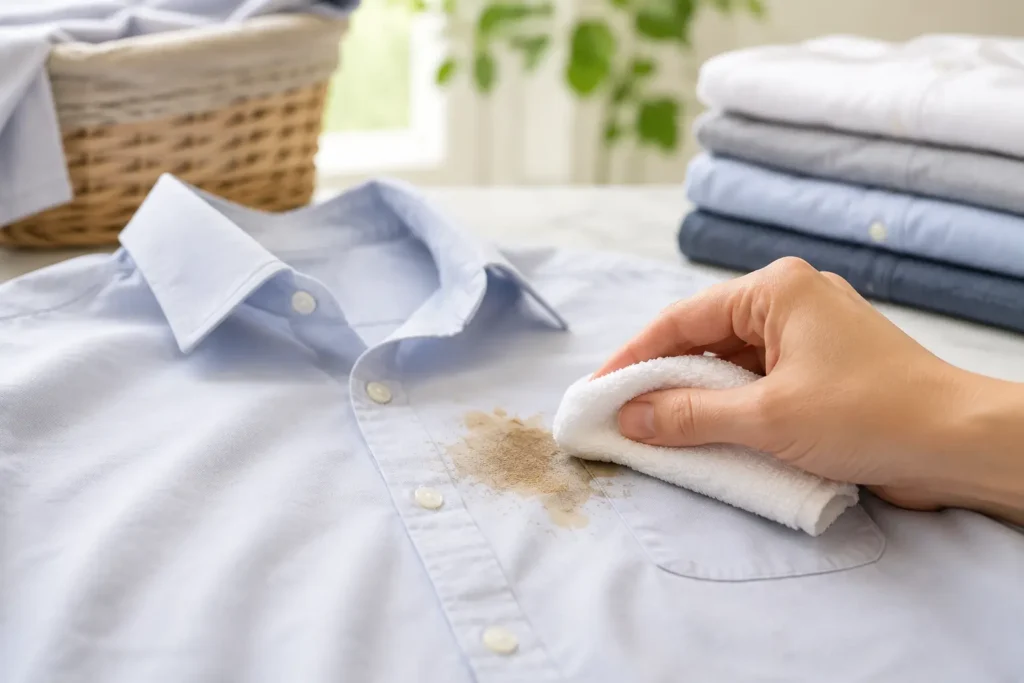
A single drop of truffle oil during a fine-dining experience or a stray splash of saffron-infused curry in a South Mumbai boardroom can feel like a death sentence for a bespoke garment. The panic is instinctive: we reach for a napkin and begin rubbing. However, in the realm of high-end textile care, that friction is the first step toward permanent structural damage.
To effectively remove grease stains from clothes, one must move beyond scrubbing and enter the realm of molecular extraction. Grease is not merely a surface pollutant. It is a bonding agent that integrates with the fabric’s physical structure. Understanding lipid chemistry is the only way to restore a garment to its original state without causing irreversible damage.
Key TakeAways
- Blot, Don’t Rub: Use a dry microfiber cloth to lift surface lipids without damaging the weave. You must never rub the stain.
- Use pH-Neutral Surfactants: Avoid harsh household degreasers that cause dye bleed; choose professional-grade pH-neutral surfactants.
- Trust the Experts: For set-in stains or luxury fabrics like silk and cashmere, professional intervention at Bianca Cloth Spa is essential to prevent permanent fibre fatigue.
The Molecular Challenge: Why Water Alone Fails Grease
The fundamental reason grease stains on clothes are so persistent lies in their chemical signature. Lipids (fats and oils) are hydrophobic, meaning they repel water. When you apply water to an oil spot, the surface tension prevents the water from penetrating the oil. The water slides over the top while the oil remains tucked safely inside the fibres.
Also, many textiles, especially synthetics like polyester, are lipophilic. They naturally love oil and pull it into the core of the yarn.
The Heat Trap: A Common Professional Misstep
A persistent myth holds that boiling water cures grease. While heat can melt certain solid fats, it poses a severe risk. Excessive heat can cook the proteins found in culinary oils, permanently bonding them to the fibre. Even worse, high temperatures can melt lipids into the fibre core of synthetic blends, making the stain a permanent part of the fabric’s molecular DNA. Precision-controlled cleaning at Bianca Cloth Spa is thus vital to garment longevity.
The Professional's 4-Step Extraction Protocol
When a spill occurs, your goal is extraction, not dispersion. While immediate action helps, true restoration requires the technical precision of our guide to common stains, which only a professional can remove.
Step 1: The Absorbent Lift (Capillary Action)
You may have heard the term ‘capillary action’ in a front-load washing machine advertisement. It is through this action that cloth acts as a microscopic sponge, drawing the liquid oil out of the fibres.
But before introducing any liquid, address the excess. Do not wipe. Use a clean, dry microfiber cloth to blot the area.
Step 2: Surfactant Selection
Lift the surface oil first. Then, proceed to break the remaining bond. A surfactant (surface-active agent) is required to bridge the gap between oil and water. Unlike harsh household soaps that can strip fabric dyes, Bianca Cloth Spa utilises pH-neutral surfactants and eco-friendly detergents engineered specifically for lipid emulsification and oil stains.
Step 3: The Mechanical Dab, Yes, Dab Never Rub
We cannot stress this enough: never rub a stain. Rubbing causes fibrillation (the microscopic breaking of the fibre ends). It creates a faintly fuzzy patch that catches light differently, making the area look like a permanent stain even if the oil is gone. Our technicians use specialised tools to agitate stains at a molecular level, without the abrasive friction of traditional methods.
Step 4: The Solvent Flush
After emulsification, you must flush the grease away. Household attempts often result in a ringing effect (a dark halo) where the dissolved oil settles along the edge of the damp area. Professional finishing ensures a uniform, dry finish, eliminating the risk of halos and water spots.
Fabric-Specific Triage: The Risk Matrix
Fabric Type | Risk Level | Primary Danger | Professional Solution |
Cotton & Linen | Medium | Over-scrubbing | Targeted Enzyme Wash |
Synthetics | Medium | Lipid Bonding | Hydrocarbon Solvent |
Silk & Rayon | High | Water Spotting | Specialised Dry Cleaning |
Wool & Cashmere | High | Felting/Shrinkage | Soft-Fluid Technology |
The Set-In Stain: Is It Ever Too Late?
A set-in stain has either oxidised over time or has been through a home dryer cycle. Heat acts as a catalyst, baking the oil into the fibre. To recover a set-in stain, the grease must be re-liquefied. It requires industrial-grade solvents or enzyme treatments containing lipase. At Bianca Cloth Spa, we specialise in technical stain recovery, revitalising garments previously thought to be unsalvageable.
The Mumbai Humidity Lock
In high-humidity environments like Mumbai, the stakes are higher. Moisture in the air prevents grease stains from drying out, creating a sticky surface that attracts environmental pollutants (soot, vehicle exhaust, and dust). Within hours, a clear oil spot can turn into a dark grey blemish. Professional intervention ensures these airborne particulates are removed before they permanently bond to the grease.
Frequently Asked Questions (FAQs)
Yes. While home remedies often fail once a stain is baked in, our technicians use industrial enzymes to break down oxidised fats, allowing for successful extraction even after the stain has set.
We call it ringing. It occurs when cleaning agents and dissolved oil migrate to the edge of the damp area. We prevent this by using precision flushing and professional drying techniques that ensure a uniform finish.
No. Household soaps often have high pH levels that strip natural proteins (lanolin or sericin), leaving the fabric brittle. We use pH-balanced detergents specifically formulated for luxury-grade fibres.
Ensure immediate drying and use an anti-bacterial rinse to eliminate the source of the odour rather than masking it with perfume.
Humidity keeps oil tacky, causing it to trap city soot and dust. It turns a simple splash into a complex composite stain. Our advanced process addresses both the lipid base and the trapped pollutants.
Blotting uses vertical pressure to lift liquid; rubbing uses horizontal friction, which breaks fibres (fibration). Rubbing often causes permanent aesthetic damage, even if the stain is removed.