
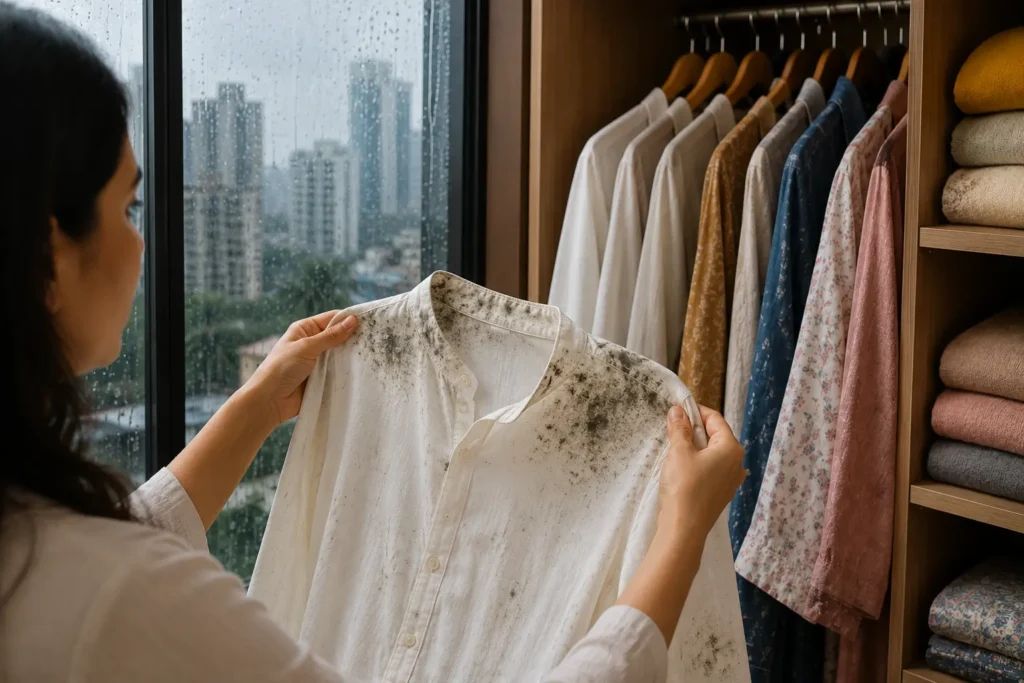
When the heavy July baarish finally breaks over Marine Drive, the city breathes a collective sigh of relief. But as you step off the damp street and retreat indoors, an invisible, microscopic siege is already underway.
You open the heavy, veneered doors of your climate-controlled cupboard. Before you see a single pale bloom on a velvet lapel, you smell it. It is a faint, earthy dampness cutting sharply through your custom cedar room fragrance. That distinct scent is not merely trapped moisture; it is the olfactory footprint of biological decay. It is the sound of a memory quietly fraying in the dark.
Whether it is a meticulously woven ₹5,000 cotton-silk passed down from a grandmother, or a newly tailored bespoke jacket, the emotional devastation of monsoon damage feels exactly the same. A price tag does not define true luxury; it is measured by the weight of the stories woven into the fabric. You do not merely own these garments. You are their custodian for the next generation.
Yet, when panic sets in, we turn to the internet. We deploy harsh household chemicals, treating our irreplaceable heritage like bathroom tiles. It is your preservation dossier on how to defend your history.
The Biology of the Bloom: Why Heritage Suffers Most
There is a cruel irony to textile care: the more authentic the fabric, the more vulnerable it is to the elements.
Inexpensive, fast-fashion garments survive the monsoon completely unscathed because they are spun from synthetic plastics like polyester. True heritage, however, relies on living, organic matter. Pure mulberry silk, raw linen, vicuña, cashmere, and full-grain leather are inherently hygroscopic; they naturally absorb the ambient coastal moisture.
When Mumbai’s chip-chip humidity breaches the 80% threshold (a metric closely monitored by global textile conservation institutes), your wardrobe stops being a storage space and transforms into a highly efficient bioreactor. To airborne fungal spores such as Aspergillus, your treasured garments are a literal food source.
Mould does not merely “stain” your clothes. Microscopic root systems called mycelium penetrate the weave, excreting enzymes that actively digest the fibroin proteins in silk. For a comprehensive scientific breakdown of how to identify these early biological threats before they spread, review our dedicated guide on mildew on clothes: causes, signs, and removal.
Once colonised, these fungi consume residual tanning oils in designer suede (a crisis best handled by professional leather care), leaving pale scars that eventually crack the hide. Perhaps the greatest tragedy occurs within our traditional Indian bridalwear. The salt-laden air, combined with trapped wardrobe moisture, creates an acidic micro-environment. The reaction triggers rapid galvanic corrosion, turning the pure silver threads of a master karigar’s zari embroidery an irreversible, dull black.
The Architecture of Decay
It is easy to blame yourself, but the fault often lies within your home. Mumbai’s high-rises are engineering marvels, yet concrete remains deeply porous. During torrential downpours, external building walls absorb massive amounts of rainwater.
This moisture transfers straight through the masonry and directly into the back panels of flush-mounted walk-in closets. Because these architectural masterpieces lack breathing gaps, they create a localised microclimate. Your central air conditioning drops the temperature in the bedroom, but behind the closed closet doors, the stagnant, damp air becomes the perfect incubator for fungal growth.
The Conservation Divide: Preservation vs Experimentation
When we spot a green fungal bloom on a cherished piece of clothing, our instinct is to reach for a quick fix. We scrub baking soda into Banarasi brocades, creating an abrasive paste that acts like microscopic sandpaper, permanently shattering the tensioned silk floats. We douse delicate pashminas in vinegar, causing violent pH drops that destabilise botanical dyes, making rich borders bleed irreparably. We use chlorine bleach, which physically melts protein fibres into brittle dust.
What feels like a rescue mission is often the exact moment the fabric’s structural integrity is permanently broken. Institutional-level bridal & heirloom restoration at Bianca Cloth Spa is an analytical science. We understand that saving a garment requires precision, not guesswork.
The Science of pH-Neutral Treatment
- Controlled pH Balancing: We align our chemistry strictly with the fibre’s natural state, treating fungal stains without hardening silk or burning wool.
- Frictionless Residue Removal: We utilise non-aqueous localised spotting to extract contaminants without abrading the weave or dissolving the specialised adhesives holding heavy sequins in place.
- Dye-Stability Assessment: Before any treatment, microscopic colourfastness testing ensures intricate patterns and linings remain chromatically locked.
- Zari-Safe Treatment: Our methods inertly lift organic matter without oxidising metallic alloys, ensuring your heritage borders retain their brilliance.