

You invest heavily in your personal image and wardrobe. You purchase a vivid silk dress or a bespoke navy suit. You expect these premium garments to maintain their rich original hues. Instead, you watch the fabrics look aged and washed out after a single season.
This frustration plagues many affluent professionals today. Luxury fabrics demand meticulous and scientifically sound attention. Understanding exactly why clothes fade forms the absolute foundation of premium garment care.
We diagnose this common wardrobe failure daily. We see exquisite textiles ruined by improper maintenance. You need expert-backed solutions to protect your valuable investments.
Lorem ipsum dolor sit amet, consectetur adipiscing elit. Ut elit tellus, luctus nec ullamcorper mattis, pulvinar dapibus leo.
Key TakeAways
- Clothes fade due to UV exposure, harsh detergents, friction, heat, and hard water.
- Sunlight breaks down dye molecules, causing irreversible colour loss.
- Aggressive washing and drying accelerate fabric wear and fading.
- Hard water minerals can dull colours and affect fabric appearance.
- Cold-water washing and reduced wash frequency help preserve colour.
- Professional garment care protects delicate fabrics and maintains colour vibrancy.
- Luxury garments require specialised cleaning methods to extend their lifespan.
The Mechanics of the Fade: The Mumbai Factor
Black denim loses its lustre because the dye, fibre, and finish are stressed by friction, wash chemistry, heat, and environmental exposure. The Mumbai climate accelerates this normal wear through hygroscopic swelling (humidity making fibres prone to abrasion) and hard water residue (minerals acting as a subtle abrasive on the fabric surface).
To maintain the integrity of your designer wardrobe, transition from ‘washing’ to the Bianca Preservation Protocol.
The 9-Point Preservation Protocol
1. The Inversion Mandate
Surface abrasion is a primary cause of fading. Always wash denim inside out to ensure the mechanical action of the wash cycle affects the interior yarns rather than the jeans’ visible face.
2. pH-Balanced Cleansing
Standard detergents are often too alkaline for luxury cotton. Use a gentle, pH-balanced detergent formulated for dark garments. Such detergents keep the fibre cuticle smooth and the pigment secure.
3. Thermal Discipline
Heat can accelerate colour loss and reduce the life of stretch denim fibres. Wash exclusively in cold water to prevent the thermal release of dye molecules from the cotton substrate.
4. Zero-Heat Curing
Never utilise a tumble dryer. Air-dry in the shade to reduce light exposure and heat stress. The air-drying process preserves both the garment’s deep carbon colour and its original silhouette.
5. Mineral Management
Hard water leaves a chalky mineral residue that obscures pigment. Recognise when your denim feels crunchy or looks dull, which requires specialist care to remove mineral residue without stripping colour.
6. The Wash Zero Strategy
The most effective way to prevent fading is to reduce wash frequency. Defer the water stress of a full cycle by utilising antimicrobial mists or spot-cleaning minor marks with a damp, lint-free cloth.
7. Atmospheric Protection
Intense sunlight is a natural bleaching agent. UV exposure weakens the depth of dark colour by breaking molecular bonds. Ensure your drying area is well-ventilated but entirely shielded from direct sun.
8. Friction Awareness
Be mindful of high-abrasion activities. In humid environments, cotton fibres retain moisture and swell, making them significantly more vulnerable to dye loss through movement and contact.
9. Professional Calibration
True textile conservation occasionally requires the touch of a specialist. Entrust your denim to a cloth spa that understands the distinction between a shuttle-loom weave and high-recovery stretch fibres.
Environmental Impact on Denim Longevity
Stress Factor | Effect on Black Denim | The Strategic Fix |
Aggressive Detergents | Strips dye and disrupts fibres | Use pH-balanced dark-wash formulas |
Hard Water Residue | Dulls colour; affects texture | Specialist care to remove mineral residue |
UV Exposure | Weakens colour depth (bleaching) | Shade drying to reduce light exposure |
Mechanical Friction | Causes localised fading | Wash inside-out; reduce wash frequency |
The Bianca Protocol: Archive-Grade Care
While common advice suggests DIY fixes like salt soaks, these methods are often unreliable for premium textiles. At Bianca Cloth Spa, we treat your denim as a long-term asset. Our professional service addresses the specific challenges of the Mumbai environment, restoring softness and drape without the aggressive agitation that causes dye loss.
Maintain the prestige of your investment. For a deeper scientific dive, explore our guide on how to keep black and dark-coloured clothes from fading through our professional lens.
[Experience Professional Denim Preservation at Bianca Cloth Spa]
The Science Behind Why Clothes Fade
Understanding why clothes fade requires examining the harsh chemical and physical forces that destroy dye bonds.
Poor dye quality in fast fashion certainly accelerates this colour loss. However, even the highest-quality designer garments face considerable environmental threats. We must identify the core culprits destroying your clothing.
Textile fading results from a multi-factor degradation of the fabric. It involves complex photochemical and aggressive hydrodynamic forces. You cannot stop fading by simply changing your detergent brand. You must understand the underlying science first.
Photodegradation and UV Rays
Textile experts call this destructive process photodegradation. UV radiation contributes up to 40% of all fabric fading. This damage occurs constantly, even in distinctly non-sunny climates.
Modern manufacturers use the dye fastness scale 1 to 8 to grade light resistance. Natural fabrics consistently score lower on these rigorous tests without specialised chemical treatments. When reactive dyes are exposed to UV light, the light energy breaks the covalent bonds that hold the colour to the fibre.
The sun bleaches dark colours relentlessly over time. You must protect your wardrobe from direct natural light. Ambient room light shining through bedroom windows also causes severe fold-line fading. Storing your luxury garments in dark, climate-controlled spaces prevents this specific form of degradation.
Chemical Stripping and Harsh Detergents
Standard commercial detergents contain aggressive chemicals and optical brighteners that strip away rich, dark colours.
These supermarket products claim to thoroughly clean your clothing. In reality, they aggressively attack the vulnerable dye molecules. They alter dark colours to make whites appear artificially brighter.
We recommend avoiding these commercial cleaning agents entirely. They compromise the delicate colourfastness of premium fibres. Low-quality dyes dissolve rapidly when exposed to these harsh chemical agents.
You must select enzyme-free detergents for your delicate silks and fine wools. Furthermore, we advise selecting natural fibres when shopping. These organically certified fabrics meet stricter ecological and colourfastness standards, ensuring greater longevity and sustainability.
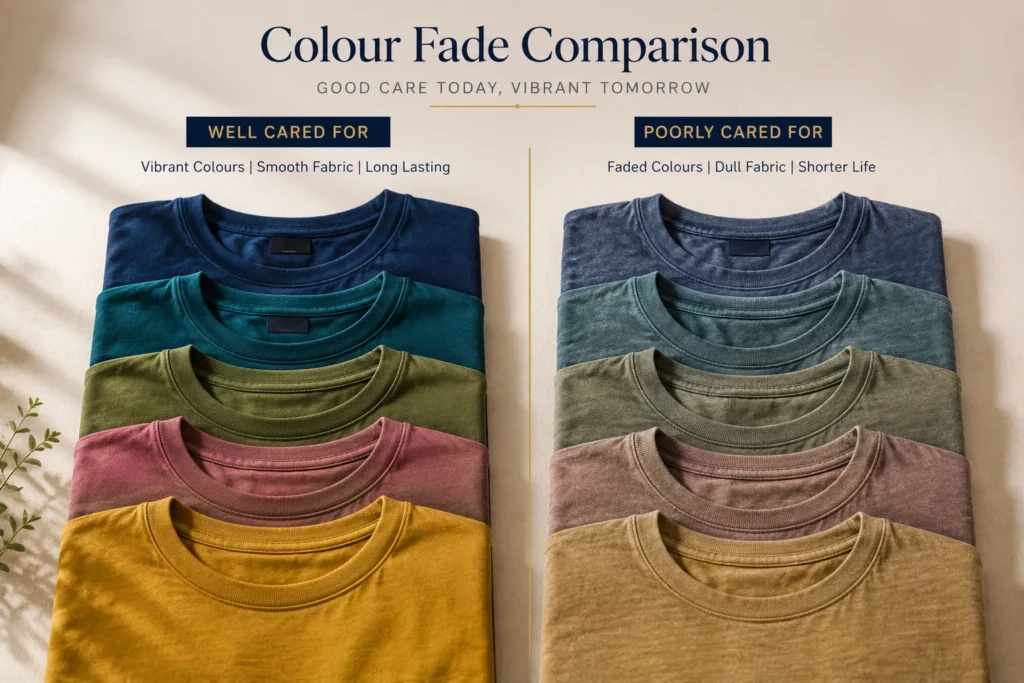
Friction and Agitation in the Drum
Washing machines create violent friction that breaks fibres and dulls the pristine finish of premium garments. Mechanical agitation forces garments to rub abrasively against one another. This results in up to 25% dye migration per cycle, as measured by ASTM D1230 rub tests. This harsh action loosens the dyes permanently from the fabric core.
Tumble dryers significantly exacerbate this mechanical friction. The spinning drum causes microscopic abrasions on the fabric surface. These tiny broken fibres scatter light differently. This light scattering makes the fabric colour look visually faded and exhausted.
You must respect the delicate nature of luxury weaves. Aggressive machine cycles destroy the careful work of master tailors. Hand washing provides a safer alternative, but it still involves the risk of mechanical rubbing.
Hard Water Mineral Deposits in Mumbai
Calcium and magnesium in hard water trap dirt over dyes, worsening fading by 20 to 30 per cent.
Hard water leaves a dull, invisible film on your entire wardrobe. Affluent neighbourhoods across Mumbai experience particularly high levels of these harmful hard-water minerals.
These stubborn minerals prevent detergents from working effectively. They trap soap scum directly into the fabric weave. This buildup masks the garment’s original colour and ruins its luxurious texture.
To combat this regional issue, you must use specialised chelators, such as EDTA. These chemical agents bind to calcium and magnesium tightly. They deliver 15-20% better rinse efficacy in Maharashtra water. This regional tap water frequently exceeds 300 ppm in total dissolved solids. They ensure your washing water complies with strict ASTM textile care norms.
The Prevention Protocol: How to Keep Clothes Colour Bright
You must adopt a meticulous, low-temperature care routine to safely lock dyes into your garments.
Prevention strategies focus heavily on gentle and disciplined care routines. You can prevent fabric colour loss through consistent habit changes. The following steps show you exactly how to keep clothes’ colours bright safely.
Always wash your garments in cold water exclusively. Water temperatures above thirty degrees Celsius dissolve modern dyes rapidly. Cold water minimises dye solubility and protects the fabric structure. Turn your clothing inside out before washing to shield the outer surfaces from damaging drum abrasion.
Many blogs suggest adding white vinegar to set dyes permanently. We must clarify this common misconception. Vinegar only effectively sets historical direct dyes. It offers no protection against the modern reactive dyes used universally since the 1990s. It acts as an excellent mineral stripper, removing hard water buildup and making colours look temporarily brighter.
You must adapt your drying routine for humid Indian climates. Instead of risking sun damage outdoors, air-dry your garments indoors. Use a fan to maintain gentle, consistent airflow after washing to prevent mould growth while keeping the fabric safe from UV rays.
Reduce your washing frequency to promote genuine sustainability. You should wash structured garments and silks only after three to five wears. Less washing means less mechanical stress and fewer lost dye molecules.
The Professional Intervention for Premium Garment Care
High-net-worth wardrobes require expert dry cleaning solvents that clean delicate fabrics without lifting dyes.
Home washing poses a severe liability for bespoke luxury items. Water physically expands natural fibres and releases their expensive colours. Professional dry cleaning circumvents this structural risk entirely.
Our exclusive premium garment care services utilise advanced, non-aqueous solvents. These specialised fluids dissolve oils and stubborn stains safely. They leave the vulnerable dye molecules completely undisturbed. Your garments return looking pristine and vibrant.
We highly recommend professional cleaning for silks, fine wools, structured, tailored garments, and heavy household textiles.
Colour Preservation Matrix
This table outlines the crucial differences between risky home habits and safe professional solutions.
Fading Culprit | DIY Mistake | The Professional Solution |
UV Radiation | Drying clothes outdoors in direct sunlight | Utilising controlled, climate-regulated drying rooms |
Friction | Using aggressive washing machine cycles | Employing gentle, solvent-based immersion cleaning |
Chemicals | Using harsh optical brighteners at home | Applying pH-balanced, dye-safe cleaning agents |
Hard Water | Washing garments in untreated tap water | Using pure, filtered dry cleaning fluids |
Heat Damage | Using domestic tumble dryers constantly | Using ambient air and specialised tensioning equipment |
Secure Your Wardrobe's Longevity Today
You must take decisive action immediately to protect your investment pieces from permanent colour damage.
Stop leaving your bespoke garments to the mercy of harsh home appliances and damaging hard water. Trust the seasoned experts to maintain your clothing’s original brilliance.
Book a comprehensive wardrobe assessment with our textile specialists today. Schedule a Mumbai pickup for monsoon-ready wardrobes and experience true textile preservation. Contact our dedicated concierge team now to secure your luxury collection.