
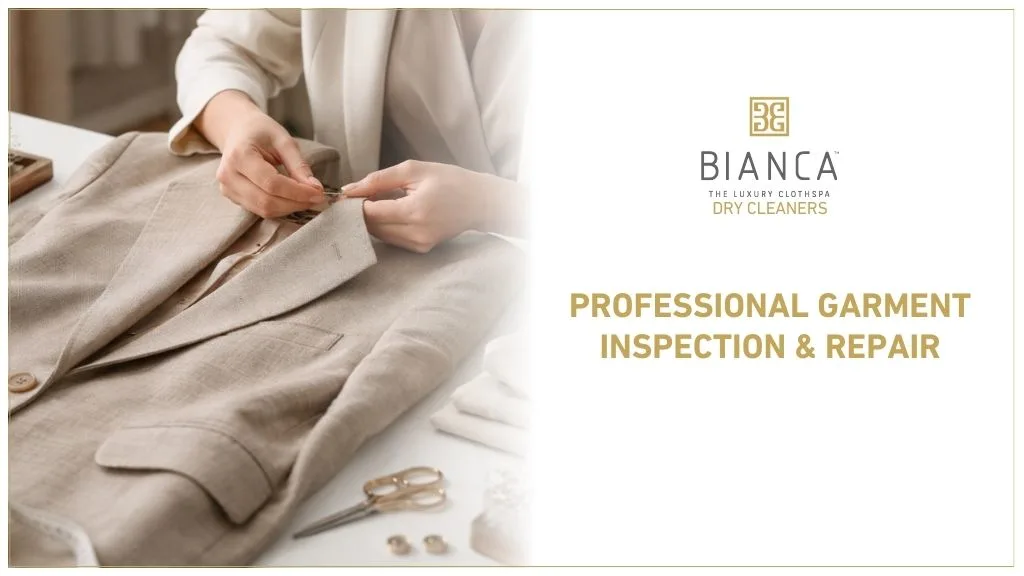
When most people think of dry cleaning, they imagine solvents, machines, and pressing. But true garment care begins much earlier—with professional inspection and repair. At Bianca Cloth Spa, dry cleaning does not start until every garment has been carefully examined by trained specialists and, where required, repaired before cleaning.
This approach is deliberate. It is designed to protect garments, preserve their structure, and prevent avoidable damage during the cleaning process. Inspection and repair are not optional extras at Bianca—they are essential steps in responsible garment care.
The Hidden Risks of Skipping Garment Inspection
Many garments arrive for cleaning with pre-existing issues that are easy to miss in everyday wear. A seam that has slightly weakened, a hem that has begun to fray, or a button that feels secure but isn’t fully anchored—these details may go unnoticed until the garment undergoes cleaning and pressing.
Dry cleaning, while gentle on intact fabrics, involves:
Mechanical movement
Exposure to solvents
Heat during finishing
When a garment already has weak points, these processes can turn minor issues into visible, irreversible damage.
Skipping inspection means cleaning a garment without understanding its vulnerabilities. Bianca’s process is designed to eliminate that risk.
Professional Garment Inspection at Bianca
Before any garment is accepted for dry cleaning, Bianca’s specialists conduct a hands-on, fabric-specific inspection. This is not a cursory visual check—it is a detailed evaluation informed by experience with luxury, delicate, and everyday garments alike.
During inspection, Bianca’s team checks for:
Loose or weakened seams
Frayed hems or stressed stitch lines
Missing, loose, or damaged buttons and closures
Fragile or worn linings
Early signs of fabric fatigue or thinning
Loose embellishments, embroidery, or decorative elements
This step allows the team to understand the garment’s condition fully and determine the safest way to proceed.
Why Bianca Repairs Garments Before Dry Cleaning
Once an issue is identified, Bianca does not wait for damage to occur. Necessary repairs are carried out before the garment enters the dry-cleaning cycle.
This repair-first approach is central to Bianca’s philosophy.
Repairs completed prior to cleaning include:
Securing loose seams and reinforcing stress points
Precise hemming and fit adjustments
Darning or stabilising minor tears
Replacing or tightening missing or damaged buttons
Strengthening fragile areas before cleaning and pressing
By repairing first, the garment becomes structurally sound—able to withstand cleaning, movement, and finishing without further deterioration.
Why Repairing After Cleaning Is Often Too Late
In many standard dry-cleaning processes, repairs are addressed only after damage has occurred. At that stage, options are limited. A seam that has split during cleaning may never return to its original strength. A tear that spreads under heat may permanently alter the garment’s shape.
Bianca’s approach prevents this scenario altogether.
Repairing before cleaning:
Prevents damage rather than correcting it
Preserves original garment construction
Reduces the need for extensive future repairs
Repairing after cleaning:
Often means dealing with worsened damage
Can compromise appearance and longevity
Limits restoration possibilities
This distinction is what separates standard cleaning from expert garment care.
Why Inspection & Repair Matter Even More for Premium Garments
Certain garments demand a higher level of attention:
Silk, linen, velvet, and wool
Beaded, embroidered, or embellished clothing
Tailored jackets, blazers, and coats
Occasion wear and designer pieces
These garments are often expensive, sentimental, or irreplaceable. Damage during cleaning is not just inconvenient—it can be permanent. Bianca’s inspection-and-repair process acts as a safeguard, ensuring these garments are treated with the care they deserve.
Alterations & Repairs as Part of Long-Term Garment Care
Bianca’s alterations and repairs service is not limited to preventing damage—it also enhances fit, comfort, and longevity.
Whether it’s adjusting trousers for a better fall, reinforcing areas of frequent wear, or repairing small imperfections, each alteration is executed with precision. Bianca’s skilled tailors work across a wide range of fabrics and garment styles, ensuring repairs are discreet, appropriate, and respectful of the original design.
The objective is not to change garments unnecessarily, but to help them:
Fit better
Wear better
Last longer
A Clear Difference in Approach
| Standard Dry Cleaning | Bianca’s Professional Care |
|---|---|
| Cleaning begins immediately | Inspection comes first |
| Repairs after damage | Repairs before cleaning |
| One-size-fits-all process | Fabric- and garment-specific care |
| Focus on speed | Focus on preservation & longevity |
This difference may not always be visible immediately—but it becomes evident over time, as garments maintain their structure, appearance, and wearability.
Sustainability Through Thoughtful Garment Care
Inspection and repair before dry cleaning also support a more sustainable approach to clothing care. Extending the life of garments reduces unnecessary replacement, lowers waste, and encourages mindful wardrobe choices.
By repairing rather than discarding, and by protecting garments during cleaning, Bianca supports a philosophy of responsible ownership and long-term use.
Final Thoughts
At Bianca Cloth Spa, garment inspection and repair are not secondary services—they are foundational to the dry-cleaning process. Every garment is assessed, stabilised, and prepared before cleaning begins.
Because true garment care is not about reacting to damage—it’s about preventing it.
And that begins with inspection, repair, and an uncompromising commitment to doing things the right way.