
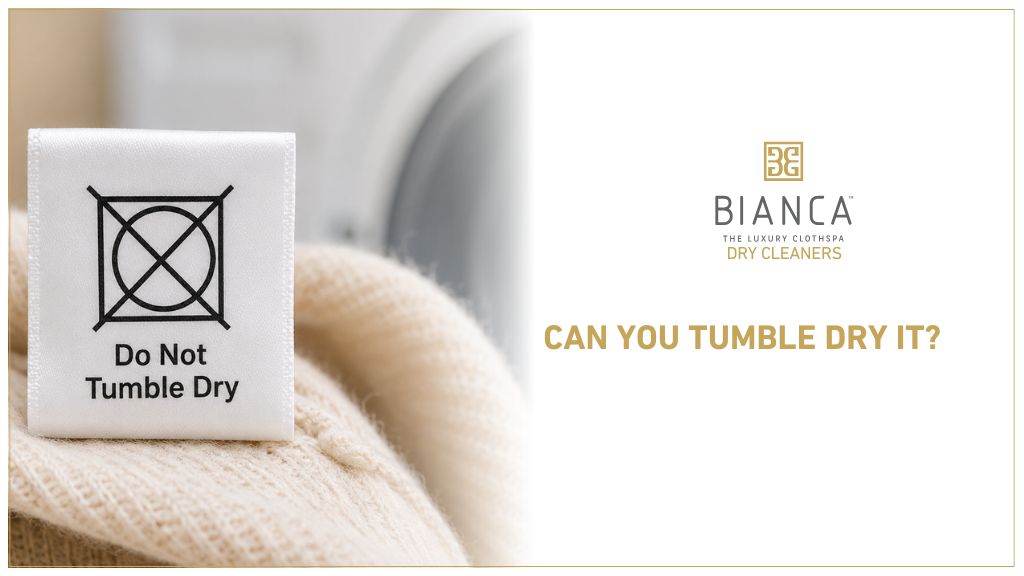
Machine drying subjects fine fabrics to harsh heat and kinetic friction, causing irreversible shrinkage, warped elastics, and delamination. The ‘do not tumble dry’ symbol demands air-drying to preserve the structural integrity of your garments. Entrusting your wardrobe to Bianca Cloth Spa ensures bespoke preservation without the silent risks of machine drying.
What Does 'Do Not Tumble Dry' Mean? The Insider's Blueprint for Fine Fabric Longevity
Machine drying fine clothes feels incredibly fast and easy. Yet, behind this speed hides a harsh truth. A tumble dryer uses intense heat and rough spinning to dry your garments.
When a care tag displays a “Do Not Tumble Dry” symbol, it issues a firm warning. Ignoring that pictogram invites a swift, irreversible decay of your garments.
The Hidden Violence of the Tumble Dryer
Heat Melts the Polymer Chains
Elite designer pieces feature delicate blends of silk, wool, and technical synthetics. These materials possess a strict heat threshold. When the internal drum exceeds this limit, the polymer threads soften. The fibres yield, stretch, and warp, ruining the tailored shape of your garments.
The Damage of Kinetic Friction
Dryers rely on both kinetic and thermal energy. Tumbling violently bashes your clothes against the metal drum. This constant impact snaps micro-threads and thins the weave. Over time, the lint filter fills with the ruined pieces of your finest shirts and trousers.
Decoding the Care Label
Look closely at your clothing tag. You will see a square with a circle inside. That symbol signals that machine drying poses no immediate threat.
When you spot a firm cross over that pictogram, it commands you to stop. Do Not Tumble Dry.
Understanding Dimensional Ruin
Disregarding this symbol triggers two distinct disasters:
- Relaxation Shrinkage: Spinning under tension stretches the yarns. Heat and moisture force the tension to release, causing the fabric to retract violently.
- Felting Shrinkage: Animal protein fibres, such as cashmere and wool, react terribly to friction. Heat opens the microscopic scales on the fibre shafts, and tumbling locks these scales together permanently.
The Myth of the Gentle Cycle
The Low Heat Trap
Many lifestyle blogs claim that choosing a low heat setting makes a forbidden item safe. That advice misleads the reader. The mechanical tumbling action alone causes severe abrasion and pulls threads, entirely independent of the temperature setting.
Elastic and Resin Failure
Dryer heat dissolves the memory in elastane. It ruins the stretch in your activewear and tailored trousers within weeks. It also strips cotton of its special anti-wrinkle coatings, leaving the fabric rough and stiff.
Learn more about how materials react to daily wear by reading this guide on how to take care of different types of fabrics.
The True Cost of Careless Drying
Ruined Inner Linings
Inspect a premium blazer. The outer shell and inner canvas fuse together using special thermoplastic adhesives. The heat inside a dryer instantly liquefies these glues. The fabric pulls away, creating bubbling along the lapels that no iron can fix.
Faded Colours
That dense mat of lint? It represents thousands of severed microfibres peeling away from your clothing. Every machine cycle robs your garments of their rich colour and soft texture.
Get answers to your daily laundry questions by browsing these everyday clothing questions answered on cleaning and fabric care.
Textile Impact Breakdown
Care Symbol | Mechanical Action | Thermal Impact | Best Strategy |
Square with crossed circle | Severe tumbling | High heat possible | Air dry flat in the shade |
Square with one dot circle | Gentle rotation | Low heat applied | Use delicate cycle only |
Square with clear circle | Standard rotation | Standard heat applied | Safe for durable cotton |
How to Air-Dry Elite Garments
Protecting your bespoke wardrobe requires strict adherence to professional drying protocols at home:
- Reshape with care: Lay wet knitwear flat on a clean, dry towel, gently pressing it back into its original dimensions.
- Avoid direct sunlight: Dry delicate items in a well-ventilated, shaded area to prevent UV rays from bleaching the natural fibres.
- Support heavy fabrics: Fold heavy garments over a thick drying rack rather than hanging them vertically, as the weight of trapped water will stretch the shoulder seams.
Frequently Asked Questions
Heat and rough tumbling shrink your clothes, ruin natural wool fibres, and melt the inner adhesives of tailored jackets.
No. The rough spinning motion damages delicate threads and breaks down elastic, regardless of the heat setting you choose.
Reshape the garment, lay it flat on a clean towel, and keep it away from the sun, or let the experts handle the cleaning.
Dryer heat breaks down the chemical finishes that keep premium cotton smooth, causing the fibres to stiffen.
Trapped moisture encourages mould and mildew if garments dry too slowly in humid weather, making professional drying environments essential for longevity.